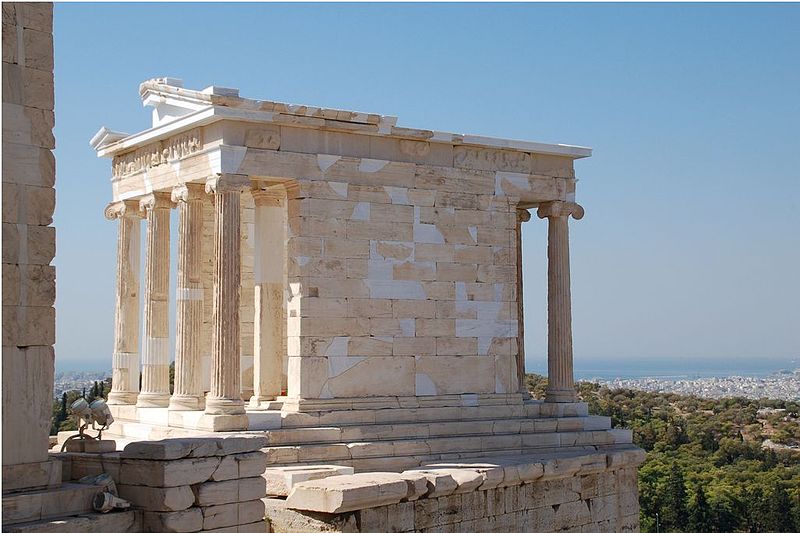
Olive oil was not only considered as a health product in ancient Greece, but something that had in essence a divine power embedded in it. It was a gift of the goddess Athena to the Athenians, therefore, it had the emblematic presence of the goddess. This stems from the myth of how Athena became the patron goddess of Athens by making an olive tree grow on the Acropolis.
"Kekrops, a son of the soil, with a body compounded of man and serpent, was the first king of Attika . . . In his time, they say, the gods resolved to take possession of cities in which each of them should receive his own peculiar worship. So Poseidon was the first that came to Attika, and with a blow of his trident on the middle of the acropolis, he produced a sea which they now call Erekhtheis. After him came Athena, and, having called on Kekrops to witness her act of taking possession, she planted an olive tree, which is still shown in the Pandrosion. But when the two strove for possession of the country, Zeus parted them and appointed arbiters, not, as some have affirmed, Kekrops and Kranaus, nor yet Erysikhthon, but the twelve gods (dodekatheoi). And in accordance with their verdict the country was adjudged to Athena, because Kekrops bore witness that she had been the first to plant the olive. Athena, therefore, called the city Athens after herself, and Poseidon in hot anger flooded the Thriasian plain and laid Attika under the sea."
- Apollodorus C2nd A.D
Olive oil was also considered a necessary item for daily sustenance. It was used to cook with and also used in the raw form in a salad dressing. In fact, a salad dressing of the ancient Greeks involved olive oil, extra virgin olive oil, vinegar, sea salt, and some honey and that then was shaken well, and it was drizzled over salads that they were preparing for eating.
Another usage of olive oil was that it was used as a base for making perfumes because it has the tendency to stay on the human skin for quite some time as it is fat soluble.
A definite proof that olive oil had a predominant place in daily lives of people in ancient Greece is the number of references to it in comedy plays of that period. For example, in the play Pluto, by Aristophanes, it says that the container is full of white flour, the wine jar is run over with great wine, and the tank is full of oil, the vials with perfumes.
It also had various medicinal usages in ancient Greece, with Hippocrates using olive oil-based ointments for all kinds of uses and for treating trauma, scratches, wounds, and concussions that are not too deeply penetrating, as the oil has healing power.
Source